Global Setting: Rules, Power, and World Promise
1/7/2026By Pollution
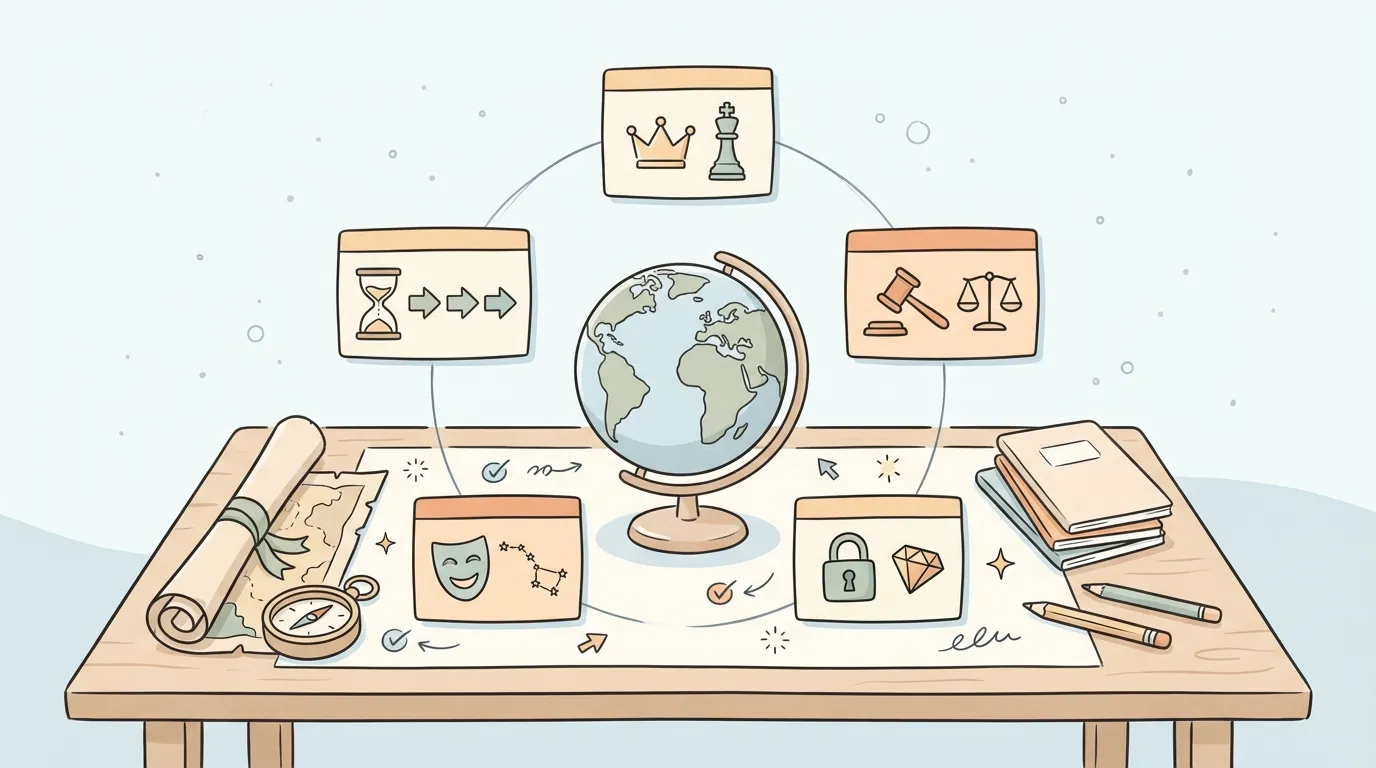
The Rules, Power, and Promise of Your World
The first step to building your setting after you’ve finished your Genre + Theme and Conflict.
Previous: Setting in Worldbuilding: Global, Regional, Local
The TLDR if you want to just get started:
- Global is your world’s operating system. You want to answer how power works, what’s normal, what’s rare, and what people believe is true.
- Keep it short and usable. Remember that you’re defining rules and pressures, not writing a timeline encyclopedia.
- A strong global layer makes the next step (regional) easy because it tells you what forces are in motion and why.
- Use the checklist: Power Map → Rules → Rarity/Restriction → Myths/Truths → History.
What “Global” is (and what it isn’t)
Global is the highest-level layer that explains why everything works the way that it does. It's not a complete map of the planet, a full chronology of every era, or a list of every country, king, and war. What it is, is the promise of what your world is like, the rules that people live under, the power structure that shapes everyday life, and the big truths (or lies) that the world runs on. In this blog, I'm going to go over the global setting and ways that you can easily set up your world's operating system, so let's get started.
What Global answers
In the previous blog, where I went over setting in general, I had a list of questions that Global answers. I'm going to be breaking them down one by one to help you come up with ideas to build your Global Checklist. As you answer these questions, keep note of any factions, alliances, religions, rules, or powers that are important to your setting in general. This will help a lot for when you transition your focus from the Global setting to the Regional setting.
1) Who holds power, and what kind of power is it?
This is where you define your world's power currency. Power is usually held through authority, wealth, force, knowledge, belief, or access. This list can definitely be expanded, but these are the general ones that I go with when I'm thinking about the greatest power (or powers) that a world respects. Here’s a simple breakdown of what that might look like for each:
- authority: laws, enforcement, institutions
- wealth: ownership, trade control, debt
- force: armies, militias, private security
- knowledge: education, secrets, restricted history
- belief: religion, propaganda, cultural legitimacy
- access: resources, technology, travel routes, medicine
Here are some questions that you should ask yourself about your world when coming up with the power:
- Who has the most control right now?
- What do they control specifically?
- What do they fear losing?
This is the seed of every future faction, alliance, and betrayal.
2) What’s the political shape of the world?
To answer this question, keep in mind that this doesn't require a global list of nations, you just need the shape of the power. Some examples of this political shape could be a dominant power with smaller dependents, several rival powers that have a fragile balance, a collapsed structure with fragmented local rule everywhere, or an old empire in decline with new powers rising.
When answering the question, here are some things to think about:
- Is the world mostly unified or fragmented?
- Is rule stable, decaying, or contested?
- Who’s expanding, and who’s holding on?
In Lord of the Rings, the world is fragmented. Middle-earth is a patchwork of separate realms and peoples, with loose alliances and no single unified power. Gondor, Rohan, the Elven realms, and Dwarven holds all seem like separate realms entirely with little to do with each other most of the time. Rule is mostly decaying and contested. The good realms are worn down. You can see leadership being strained, borders pressured, and authority being challenged or even undermined. Sauron is expanding his military pressure and influence while the free peoples of Gondor and Rohan are just barely holding on.
3) What’s rare, restricted, or dangerous?
This is where your world becomes usable fast. You want to make a short list of things that people fight over or hide, that institutions control, or that only a few can access. A few quick and easy examples would include resources, abilities, magic/technology, or knowledge. The list is pretty long for what can fit in this category, but you're going to want to choose one or several things that will make for easy and believable hooks.
When deciding on what you want to be rare, restricted, or dangerous in your setting, ask yourself the following questions:
- What’s hard to get?
- Who controls it?
- What happens if someone gets caught with it?
These are simple questions with simple answers. They create natural stakes without needing a plot.
4) What do people believe?
This is where common knowledge fits in. It defines what’s normal in conversation in your world. These are your legends, myths, assumptions, and stories. This is where religions are built. You might have a lot of answers to what people believe, but what you answer here should be part of the lifeblood of your world. What people believe to be true helps to shape everything the protagonist or players interact with, from cities and towns to people and monsters.
For this question, I like to break it down into three parts:
- What do most people believe is true?
- What do most people believe to be false?
- What do the hopeful want to be true?
You're not writing religious texts here, and your answers to these questions don't have to be the absolute truth of your setting. Your answers to these questions help you create meaningful characters that fit in your world. They understand what the norm is, can challenge it, can conform to it, or can be filled with hope for something better.
5) What are the world’s basic rules?
This is where you define the physics of your setting, or whatever that would mean for your world. The four points that usually need to be explored when coming up with your world's basic rules are:
- magic: how it works (or why it doesn’t)
- technology: how it works (or gets restricted)
- faith: how it functions (institutions, miracles, taboo)
- law: how it is enforced (fairly, violently, selectively)
- world: how it looks (conditions that are permanent)
- people: how they live (high or low class, who rules)
A few simple questions you want to ask yourself when coming up with your world's basic rules are:
- What’s possible and true?
- What costs something (risk, money, time, reputation)?
- What’s forbidden or limited?
Mistborn’s basic rules
Your world's basic rules are very important, so I might spend a little bit of extra time here. If you really want your setting to be unique, this is where you want to spend of your time when working on your global setting. Brandon Sanderson's Mistborn as an example when talking about the world's basic rules.
What’s possible and true?
There are a few important answers to what is possible. The short answer is that systemized magic exists, society is built around a rigid power structure, and the world is harsh and abnormal.
- Magic: You have Allomancy, Feruchemy, and Hemalurgy, the three major abilities that show up in Mistborn. Allomancy allows certain people to burn specific metals inside their bodies to gain specific powers, Feruchemy allows certain people to store a type of power inside a metal object and tap into it later, and Hemalurgy is the ability to steal and transfer power using metal spikes.
- People: Nobility holds legal status, wealth, and political control, while the skaa underclass is controlled through law, force, and fear. Climbing the social ladder is impossible.
- World: Ash regularly falls, and the sun is red. There's also a "mist" that's a real phenomenon people live with and fear.
What costs something?
Just because something is possible or true doesn't mean that it will always have a cost. So some of your answers to what's possible might not need to have a cost.
- Allomancy: You need a supply of the right metals to burn, and using your powers can reveal you and get you hunted.
- Feruchemy: You need to weaken yourself now in order to store power for later.
- Hemalurgy: This power costs your humanity. It requires harm to create and use it effectively and often comes with corruption and instability.
- Belief: Faith is tied to institutions and powers. Public belief can protect you or brand you.
What’s forbidden?
In Mistborn, the Lord Ruler protected his power by forbidding and limiting certain dangers to his rule.
- Unauthorized power was considered a threat to the state. Certain forms of magic are effectively illegal if they challenge the ruling order, especially anything that looks like rebellion.
- Knowledge that undermined the regime was also dangerous. Wrong histories, forbidden truths, and subversive ideas were treated as threats and not opinions. Free thought was being policed.
- Social class lines were forbidden to cross. Relationships and behavior that blurred the line between the noble and the skaa boundaries were heavily controlled.
6) What’s the history?
You want a usable past and not a full timeline. If you write a full timeline right away, you have to go back to it constantly to make sure that all of your details are accurate. It's better to have a solid structure and fill out a timeline as you go along than to have something pre-set that you are forced to follow if you want to get started with your world right away. You can be a little loose with your timeline this way, making your writing less stressful.
Use this structure:
- Beginning: What was the world like before things changed?
- Shift: What event or change reshaped everything?
- Now: What is the world like today because of that?
This is a guide for world-building for beginners. So if you want to build a complex timeline, that's definitely fine, and there are a lot of resources for it. But if you're just getting started, then this is the best way to do it. Answering these questions gives you context without having to do any lore dumping. It also gives you flexibility when creating your world to write the timeline as you go along.
Global Checklist
When using this checklist, I want you to remember that this isn't going to be everything. You don't have to try to write everything either. Write just enough to make the world feel consistent and get ready to zoom into regional. It's very easy to get absorbed into the idea of building a large-scale world, but doing that makes it very easy to burn out. A lot of the world can be discovered as you world-build on the regional and local scale, and those are the scales that the protagonist or players interact with the most.
1) Power Map (1–3 lines)
Write who runs the world and what kind of power they use.
- Who holds the most control right now?
- What power currency matters most (authority, wealth, force, knowledge, belief, access)?
- Who challenges that control (even if they’re losing)?
Output format example:
“Power is held by ___, maintained through ___, and threatened by ___.”
Follow this with 1 or 2 additional lines that describe the major power. If your world has fractured powers, include details for all of the strongest powers in this section that will affect the regional and local area. You can always include additional factions later as the local area expands.
2) Rules (3-5 bullets)
Write the basic rules people live under. These should explain what’s normal and what has consequences.
Pick rules from these categories (only use what applies):
- Magic: what’s real, who can use it, what it costs, what’s banned
- Technology: what exists, who controls it, who gets access
- Faith: what’s accepted, what’s taboo, who defines truth
- Law: what gets punished, how enforcement works, who gets exceptions
- World: permanent conditions (environment, phenomena, hazards)
- People: class structure, status, mobility, daily survival
Output format examples:
- “___ is possible, but it costs ___.”
- “___ is forbidden unless you’re ___.”
- “___ is common in ___, rare in ___.”
These are a few general examples of what your bullets can look like, but you can improvise. If you have more than 5 rules for your setting, then you can add additional bullet points as needed, but it’s best to keep the rules between 3 and 5 bullets and expand more in the regional setting where the rules are more likely to affect the local setting. Don’t overwhelm yourself with rules too early!
3) Rarity & Restriction (3 bullets)
Write out the most valuable or dangerous things in the world.
- What’s hard to get?
- Who controls it?
- What happens if you’re caught with it?
Output format example:
- “___ is rare because ___.”
- “___ is restricted by ___.”
- “If you’re caught with ___, ___ happens.”
You can always have more, but I like to keep this simple with just one or two and then add more as I zoom in. Whatever is restricted should be something that has a big impact on the world. If you have just one, that one restricted thing has greater weight alone than if there were ten restricted things.
4) Myths & Truths (3 bullets)
Write what people believe, what they reject, and what they hope for.
Use your three-part approach:
- What do most people believe is true?
- What do most people believe is false?
- What do the hopeful want to be true?
Output format example:
- “Most people believe ___.”
- “Most people reject ___ as a lie.”
- “Some people hope ___ is true.”
I really recommend just following the output for this one. You can have many beliefs and hopes, but limiting them in number makes the ones on the global scale more meaningful. If there were too many truths, it would have less of an impact when something challenges one of them. If there were too many hopes, it won’t matter if one hope is lost, because all hope isn’t.
5) History (Beginning → Shift → Now)
Write a usable past, not a full timeline.
- Beginning: what the world was like
- Shift: what changed everything
- Now: what the world is like today because of it
Output format:
- “The world used to be ___.”
- “Then ___ happened.”
- “Now ___.”
Remember to keep this part simple. You can always work on a timeline on the side as you continue your worldbuilding, but flexibility is nice to have at this stage if you’re just starting out.