Regional Setting: Make Your World Move in the Background
1/8/2026By Friends & Fables
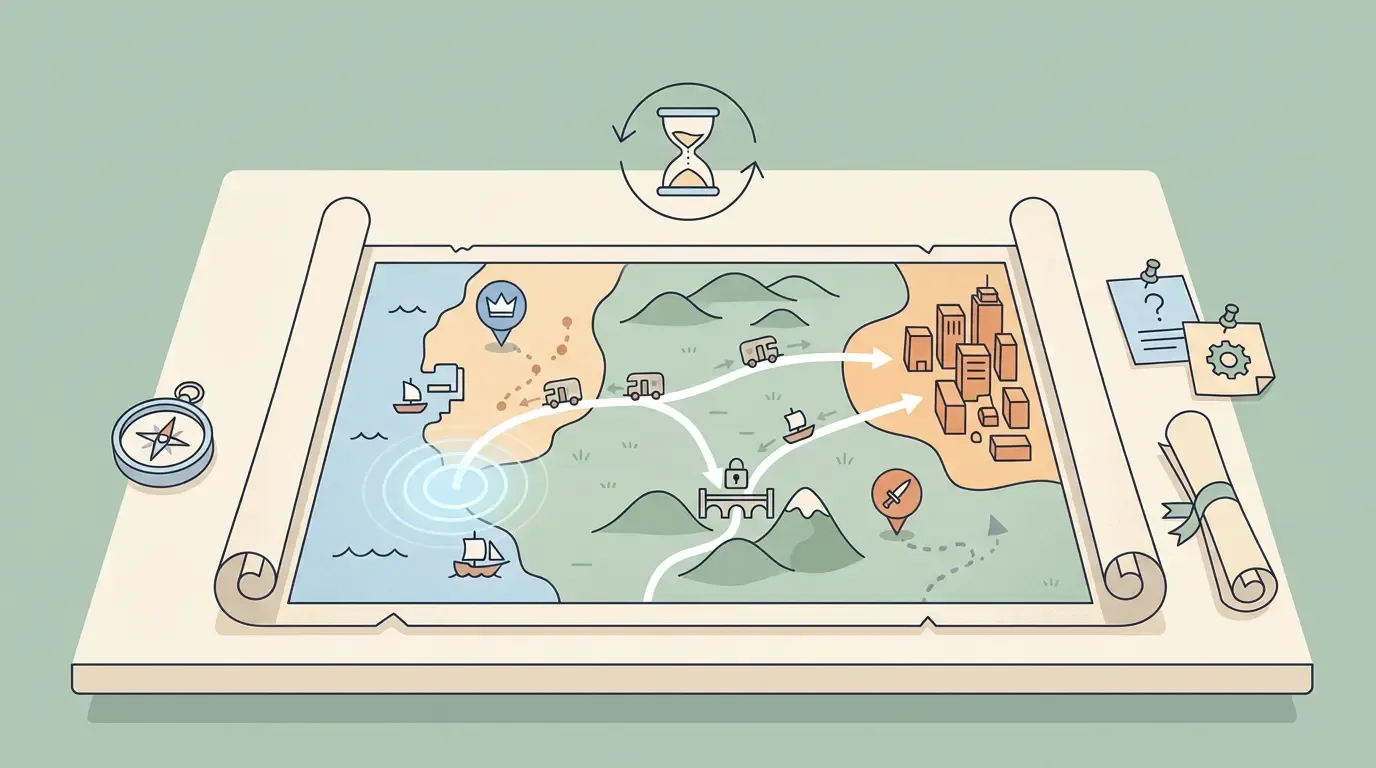
The World Moving Without The Protagonist
Global gives you the rules. Regional shows you the motion those rules create.
Previous: Global Setting: Rules, Power, and World Promise
The TLDR if you want to just get started:
- Regional is the layer where your world acts in the background. It’s where trade shifts, alliances change, threats move, policies tighten, shortages spread.
- Regional exists so the story doesn’t feel like it only happens when the protagonist/players show up.
- A strong regional layer creates ripples the local layer can feel (even if you never leave local).
- Regional often contains the “real solution,” but it should be unreachable at first through natural gates: distance, cost, knowledge, trust, timing.
- Use the checklist: Territory → Powers → Changes → Ripples → Unreachable Solution → Gates → Regional Clock.
Regional is the moving area of the world
This is where you show the world is alive outside of the main characters. It's the layer where trade routes shift, alliances form and break, threats migrate, policies change, and shortages spread. Regional should feel like a background machine that keeps turning whether anyone is watching or not.
Regional isn't just the whole world again, and it's not a massive list of places. Regional is a territory around your local stage. This is where the powers that operate across that territory are. It's where the protagonist or the players see the changes currently happening because of the conflict in the story. All of the changes that are seen at the regional stage should have ripples that can be felt locally. Think of regional as the moving parts that make the world feel alive and consequential.
What Regional answers
There are several questions that I mentioned regional answers in the Settings in Worldbuilding blog. I'll be going over those questions here and breaking them down in ways that are easy to answer that can add a lot to your worldbuilding. Something important to note is that the regional layer often contains the real solution to the local troubles. It should always be unreachable at first, but not impossible. It should be gated by time, risk, knowledge, permission, or capability. There also needs to be some kind of barrier that prevents the protagonist or the players from reaching it immediately. Later on in this blog, I will be going over ways to temporarily gatekeep the regional solution, but for now we'll go ahead and go over the questions that the regional setting answers.
1) What territory surrounds the local stage?
The beauty about defining the playground outside the starting area is that it doesn't really need to be detailed. Sometimes a lack of information can be a strength in your setting. Instead of the protagonist or the players knowing everything about a surrounding area, or finding NPCs that know everything about a surrounding area, they would be forced to do research or enter the territories in order to learn more. It makes it much easier for a worldbuilder to wait for the protagonist or players to reach a territory before writing about it. If you did a good enough job with setting the global stage, you can use what you wrote as goggles that you look at your world with and world-build what is necessary as the protagonist or players reach those areas.
When working on territory, you don’t need a detailed map. All you need is structure:
- what directions things lead
- what zones feel different from each other
- what routes connect them
- what bottlenecks and borders matter
Keep it usable:
- 3–5 regional zones (plains, coasts, districts, valleys, badlands, or whatever fits your genre)
- 2–3 travel routes people actually use
- 1–2 bottlenecks that matter (a pass, a bridge, a checkpoint, a canal, a toll road)
This gives you enough shape to understand movement and pressure. This also makes it easy for you to point in a direction for the protagonist or players to move in if they're stepping out of the local stage. Just a note, the local stage doesn't ever really disappear, it just changes. Some of the regional stage will eventually be absorbed into the local stage, because the local stage always revolves around the protagonist or the players.
2) What powers influence this area (and what do they want)?
Regional is where your global power structure gets to become active. You want to pick a set of influential forces. I usually start off with 2-4, because if you add too many, it starts to get confusing, and it's easier to make more meaningful encounters when you don't have to manage 5 or more factions.
Examples of Influential Forces:
- an authority that claims legitimacy
- a rival power trying to expand or undermine
- a resource-holder (trade, food, fuel, medicine, knowledge)
- a dangerous force (raiders, monsters, cult, storms, or whatever fits your setting)
For each influential force, you want to answer three things:
- What do they want? (simple, concrete)
- What are they doing right now? (an action, not a vibe)
- How does that touch the local area? (a ripple)
This is how you avoid “factions that only exist in lore.” Because you're creating these factions in the regional stage, you don't have to have them interact with the protagonist or the players directly. The ripples of their actions just need to be felt at the local stage. Have fun with the ways you make this happen. If the actions of these forces cause enough distress to the players, they might make moves to try and step out of the local stage and into the regional stage. When that happens, they will be making moves in the local stage that naturally bring them closer to the solution.
3) What changes are happening right now because of the conflict?
This is the heart of the regional stage. This is where you start to see active change take place. You're no longer describing the conflict in general. This is where you're describing what the conflict is doing today across the wider territory. A good regional layer has motion that you could point to. If someone asked, “What’s different this month than last month?” you’d have answers.
What I like to do is pick about three developments that are already in motion. You can choose three changes that are happening, whether anyone intervenes or not. You can make them concrete and observable, or you can keep them hidden and let the protagonist or players discover them later.
Examples of Regional Change:
- Movement: routes failing, borders tightening, refugees relocating, patrols expanding
- Relationships: alliances forming, treaties breaking, factions splintering, rivals teaming up
- Control: new laws, crackdowns, inspections, rationing, propaganda, conscription
- Resources: shortages, price spikes, hoarding, sabotage, new supply sources opening/closing
- Threats: attacks increasing, monsters migrating, raids spreading, defenses weakening
Another thing you can add is a "looming event." This can act like a ticking clock for the regional stage. It can be something that will land whether the protagonist or players act or not. This is a fun way to create a sense of agency if the “looming event” will negatively affect the protagonist or the players’ plans.
Examples of Looming Events:
- A vote (or a succession decision)
- A deadline (tax day, census)
- A festival (seasonal, celebration)
- An arrival (army, celebrity)
- A seasonal event (harvest, hunt)
This matters because it turns your regional layer into momentum instead of just a backdrop. Even if your story stays local, the world will feel like it's advancing in the distance. The local layer will also keep catching the ripples that are made in the regional layer.
4) What ripple effects can be felt locally?
This is how your regional layer stays present even if the story never leaves the local layer. Regional changes shouldn't feel like somewhere else’s stuff. It should show up as noticeable friction in daily life. These effects should be related to things people talk about, react to, and make choices around. For each regional change, you want to list 2-3 local symptoms that the protagonist or players could realistically encounter. It's important to note that these symptoms don't have to constantly be shifting and changing, they just need to be present enough to make choices feel connected to a larger world.
Examples of Symptoms:
- Price spikes (a common item doubles in cost, barter happens more often, debts pile up)
- New patrols or inspections (checkpoints, curfews, searches)
- Refugees or workers arriving (crowded shelters, new labor markets, upset locals, rising crime)
- Shortages of specific goods (empty shelves, rationing, substitutions, hoarding)
- New restrictions or permits (licenses, taxes, travel passes, “approved vendors”)
- Escalating violence at boundaries (skirmishes, raids, missing travelers, blocked roads)
- Recruitment/propaganda/help wanted notices (bounties posted, public announcements, graffiti)
Two extra tips to make ripples immediately usable:
- Make each ripple actionable.
A ripple should create a choice: pay more, break a rule, take a risk, pick a side, help someone, exploit someone.
- Tie ripples to a visible source.
Instead of “prices are up,” show why. Crime has gone up, a caravan’s been seized, there’s a new tax, there’s been a public arrest, or a shipment schedule has been changed.
Rule of thumb: if you can’t name any local symptoms, the regional change is too abstract, or it isn’t actually changing anything yet.
5) What’s the larger, usually solvable problem behind the local troubles?
Local is where the protagonist and the players deal with the symptoms. Regional is where that cause lives. The point of this step is to identify the one-step-up problem. This is the solution to the “larger problem” that, if addressed, would make multiple local troubles start to ease at once.
Examples of the Larger Problem:
- the real source of a shortage (local problem: shortage of vital medicine)
- the decision-maker behind a policy (local problem: taxes are too high)
- the institution that can authorize a solution (local problem: goblins created several camps in a local forest, and they’re beyond what the local town can handle)
- the location where proof exists (local problem: a family member was framed for murder)
- the power that must be negotiated with or defeated (local problem: a nearby kingdom declared war on yours, and your town is on the border)
Easy way to frame it is by asking the question, "What's causing the pressure that local people can't fix on their own?”
Good regional problems are also specific and actionable. You want to make sure that they're concrete and not vague so that you can get a whole lot more out of them. You also want to avoid regional problems that are too abstract early on. “The world is corrupt,” “people are afraid,” and “the empire is falling" can definitely be true, but they don't tell you what the protagonist or the players can do next.
Remember that when you're creating this usually solvable problem, you want to make sure that it isn't immediately reachable. It has to be gated by something that keeps the protagonist and the players in the local layer for some time as they are discovering more about your world.
Making the regional solution unreachable (without feeling forced)
A regional gate feels good when it's not just the author or the game master saying no. It's best when the world says not yet. The goal here isn't to block progress entirely, it's to make the progress feel like it's earned. A good gate has three traits:
- It’s visible early. You can see the door, you just can’t open it yet.
- It has a clear key. Players/protagonists can understand what would unlock it.
- The key lives locally. You earn it through local choices, relationships, and wins.
I would start off with one or two gates and stack more later if needed. It's best to feel out how many you need as the story progresses and adapt as the protagonist or players pass through them.
Examples of Natural Gates
Distance & travel danger
This is a very simple one that's easy to use. The route itself is a barrier. The time, survival, escorts, hazards, weather, or hostile territory can keep the protagonist or player from moving on to the regional solution.
What this looks like in practice:
- The road exists, but it's not a straight path, and it's a long journey. You need supplies, guides, safe stops, or protection to make it.
- The danger escalates in layers, where it's safer near the local layer, but it gets worse the deeper out you get.
- Even if travel is possible, it's costly enough that going straight there is a bad early choice.
Local keys that unlock it:
- securing a guide, a map, or a safe route
- earning transport (horse, boat, caravan slot)
- clearing a nearby threat so travel becomes viable
Cost & access
This gate requires permits, bribes, status, gear, transport, supplies, or legal clearance to get past.
What this looks like in practice:
- The regional solution is behind some kind of system that requires paperwork, tolls, licensing, ranks, or membership.
- Access isn't just money. Access can be social standing, a badge, an invitation, or a sponsor.
Local keys that unlock it:
- doing a job that earns a letter of passage
- building a reputation so guards/officials stop blocking you
- joining a guild or faction to secure the paperwork needed to pass
Knowledge
For knowledge, you might need a name, a map, a contact, or proof. When using knowledge as a barrier, it's best to keep the knowledge gated by an item or by a character that either has limited knowledge of anything else or will not befriend the protagonist or players.
What this looks like in practice:
- People might know about the regional solution, but they don't know the details.
- The "real thing" you need is buried behind misinformation, secrecy, or missing context.
- A noble refuses to speak with you until you have proof to back up your claim.
Local keys that unlock it:
- finding a witness, a document, or a symbol
- earning access to someone who knows more
- collecting proof that makes the next step possible
Trust
For trust, you just need someone to vouch for you. You might need reputation, alliances, or leverage.
What this looks like in practice:
- The people who can help you don't know you, don't like you, or don't want to risk their lives for strangers.
- Neutral factions demand trust before they share any resources, information, or protection.
Local keys that unlock it:
- helping a person or group who later sponsors you
- proving you can keep a secret or honor a deal
- gaining leverage (a favor owed, a shared enemy, evidence)
Timing
For timing, windows can open and close, events happen on schedules, and delays can create urgency. If you're using timing as one of your barriers, have other ones that keep the protagonist or players busy so that they aren't just sitting around in the story.
What this looks like in practice:
- A meeting, shipment, migration, vote, ritual, or seasonal route happens at a certain time once a month or once a year.
- Missing the window doesn't end the story, but instead changes the route forward and raises the pressure.
Local keys that unlock it:
- learning when the window opens
- influencing events so the window opens (or stays open)
The Regional Checklist
I've decided to just leave the bullet points here instead of reviewing all the parts. Use this to build regional in one go.
1) Territory (3–5 bullets)
- 3–5 zones:
- Zone 1:
- Zone 2:
- Zone 3:
- Zone 4:
- Zone 5:
- 2–3 routes:
- Route 1:
- Route 2:
- Route 3:
- 1–2 bottleneck:
- Bottleneck 1:
- Bottleneck 2:
2) Powers (2–4 groups)
Influential Force:
- Wants:
- Doing now:
- Touches local by:
Influential Force:
- Wants:
- Doing now:
- Touches local by:
Influential Force:
- Wants:
- Doing now:
- Touches local by:
Influential Force:
- Wants:
- Doing now:
- Touches local by:
3) Active changes (3 bullets)
4) Local ripples (2–3 per change)
- Change 1 ripples:
- Change 2 ripples:
- Change 3 ripples:
5) The regional “real solution” (1–2 lines)
6) Gates (pick 1–2 to start)
- Gate 1:
- Gate 2:
7) Regional clock (one sentence)
- “If nothing stops it, __________ will happen by __________.”
Next: Coming soon